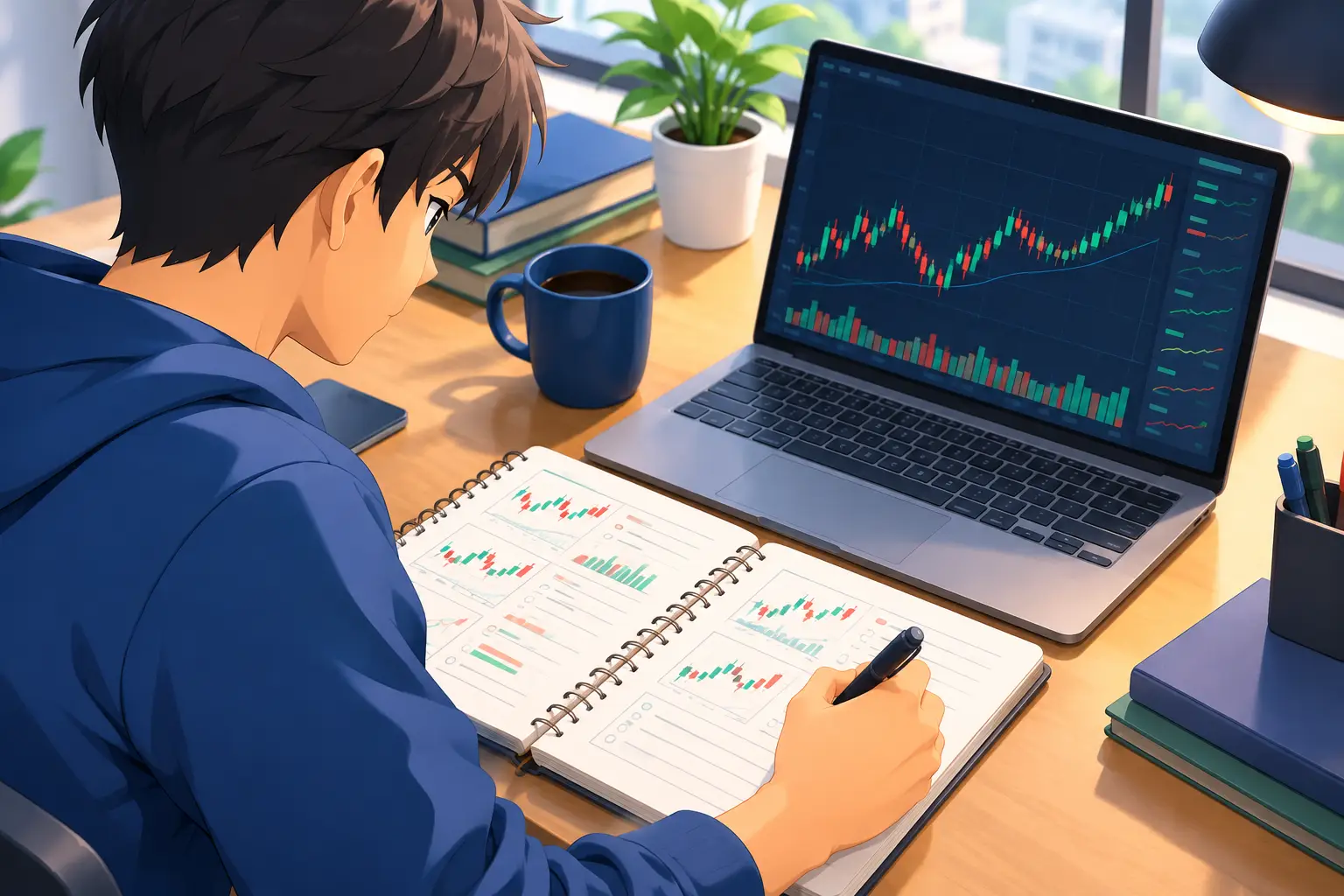
How to Track Trading Mistakes and Trade Better
A red trade is not automatically a mistake. A green trade is not automatically good trading. If you want to know how to track trading mistakes, start by separating your PnL from the quality of your decisions. That distinction is where traders stop blaming the market and start building consistency.
A well-planned long can stop out because news hits, liquidity dries up, or price action simply fails. That is a valid loss. But a trade that breaks your risk limit, ignores your setup, or gets doubled down because you do not want to be wrong is a mistake, whether it finishes green or red.
Your journal should make that difference visible. The goal is not to create a record of every bad feeling after a loss. The goal is to identify repeatable behaviors that damage your win rate, deepen drawdowns, and drain mental capital.
Why Most Traders Repeat the Same Errors
Most trading mistakes happen fast and get forgotten even faster. You chase a breakout after it has already extended, move a stop wider, take a trade outside your plan, or revenge trade after a loss. By the next market open, the details feel less urgent. A few winning trades can make the behavior seem harmless.
Without a written record, your brain tends to remember the trade outcome, not the decision process. This creates a dangerous loop: a rule-breaking trade makes money, so you repeat it; a quality trade loses, so you abandon the setup. Over time, you are training yourself to react to short-term PnL instead of executing an edge.
Tracking mistakes gives every error a name, a frequency, and a cost. Once you can see that late entries happen most often after 10:30 a.m., or that revenge trades account for a large share of your red days, improvement becomes specific. You are no longer trying to be a more disciplined trader in a vague sense. You are correcting a measurable leak.
Build a Mistake System Before You Need It
A useful mistake tracker uses a small set of clear tags. Do not create 30 categories on day one. Too many tags make journaling slow, inconsistent, and easy to avoid. Start with the behaviors that most often hurt retail traders, then add detail only when your data calls for it.
Common mistake tags include:
Entered late or chased price
Took a setup outside the trading plan
Risked more than the planned dollar amount
Moved or ignored a stop loss
Averaged down without a defined level
Sold a winner too early
Held a loser past invalidation
Revenge traded or overtraded
Traded during low-quality market conditions
Failed to confirm the setup or catalyst
The point of a tag is not to shame yourself. It is to make the trade searchable. If you tag five positions as FOMO entries this month, you can pull them up, review the screenshots, and find the pattern behind the impulse. Maybe it happens after you miss an opening-range breakout. Maybe it happens when you trade from your phone without marking levels first. The fix depends on the trigger.
Separate Outcome From Execution
Every trade should receive two ratings: one for execution and one for outcome. Execution asks whether you followed your plan. Outcome records whether the trade made or lost money.
For example, suppose you short a weak stock at resistance, use a defined stop, and cover at your target. That is good execution and a good outcome. If the stock stops you out at your planned risk, it is still good execution, even though the outcome was red.
Now consider a crypto position where you enter late, risk twice your normal amount, and happen to catch a squeeze higher. The outcome is green, but the execution is poor. This distinction prevents lucky trades from becoming bad habits.
How to Track Trading Mistakes After Every Position
The best journal is the one you can complete while the trade is still fresh. You do not need to write a page of commentary after every entry and exit. You need a fast routine that captures the decision, the evidence, and the lesson.
Use this five-part process after closing a position:
Record the facts: symbol, direction, entry and exit, position size, realized PnL, planned risk, and risk-to-reward. If you scale in or out, log each entry and exit so the final result reflects what actually happened.
Save a chart screenshot: include the setup before entry when possible, then mark your entry, stop, target, and exit. A screenshot turns a vague memory into evidence. It is much easier to spot a chase entry when you can see how far price was extended from your level.
Tag the setup: label the technical reason for the trade, such as a breakout, pullback, support bounce, trend continuation, or failed breakdown. This helps you measure which strategies deserve more attention.
Tag the behavior: add any mistake tag that applied. Be honest and precise. Do not tag a trade as revenge trading just because it lost. Tag it when the decision was driven by the need to recover a loss rather than a valid setup.
Write one sentence: explain what you did well or what you would change next time. Keep it actionable. Replace “bad trade” with “entered before confirmation and gave up a 2:1 risk-to-reward plan.”
A mobile-first journal such as Leaprr makes this process easier when you are away from your desk. The value is not just storing trades. It is connecting screenshots, custom tags, risk data, and behavior so your review has enough context to change the next decision.
Measure the Cost of Each Mistake
Counting mistakes is useful. Measuring their financial impact is better. A mistake that happens twice but causes a major drawdown deserves more attention than a minor error that appears ten times.
During your weekly review, look at each tag and ask three questions: How often did it occur? What was the average PnL when it occurred? Did it increase my planned risk or reduce my expected reward?
For instance, you may find that your breakout strategy has a solid win rate when you enter near the trigger level, but late entries have a negative average PnL. That does not mean breakouts are the problem. Your timing is. The solution might be setting alerts at key levels, waiting for a retest, or accepting that a move can happen without you.
Also compare mistake tags against green and red days. Overtrading may not look terrible on a single position, but it can be the reason your best morning gains disappear by the close. A calendar view can reveal this quickly: strong early trades followed by a string of low-quality afternoon entries is not a strategy problem. It is a discipline problem.
Watch for Mistake Clusters
One mistake often creates another. A late entry may force a wider stop. A wider stop may lead to oversized risk. An oversized loss may trigger revenge trading. If you only count the final revenge trade, you miss the chain that started it.
When reviewing a losing day, identify the first broken rule. That is usually the highest-leverage correction. Maybe your first trade was fine, but you took a second position while distracted at work. Maybe you ignored your daily loss limit after two stopped-out futures trades. Find the moment your process broke, not just the moment your PnL turned red.
Turn Data Into One Rule for Next Week
Do not try to fix every weakness at once. Traders often respond to a rough week by adding more indicators, changing strategies, and creating a complicated rulebook they will not follow. A better approach is to choose one behavior with a clear trigger and a clear response.
If your biggest issue is chasing, your rule might be: no entries more than a set percentage above the planned trigger, unless a pre-defined momentum setup is active. If revenge trading is the issue, your rule might be: after any full-risk loss, step away for 10 minutes and write the setup for the next trade before placing an order.
Make the rule measurable. “Be patient” is a good intention, but it cannot be audited. “No new positions for 10 minutes after a full stop” can. At the end of the week, review whether you followed it and how it affected your drawdown, trade count, and emotional control.
Your trading journal is not a report card. It is your evidence file. Every cleanly documented mistake gives you a chance to protect capital before the pattern gets expensive. The trader who reviews one honest chart after the close is doing more for tomorrow's performance than the trader who spends the evening searching for a new indicator.